 react-brain
Architecture
The homepage shows the 3-second version. This is the whole machine — and below the diagram, an honest mapping of each block to the real code and data that implement it (everything is open source).
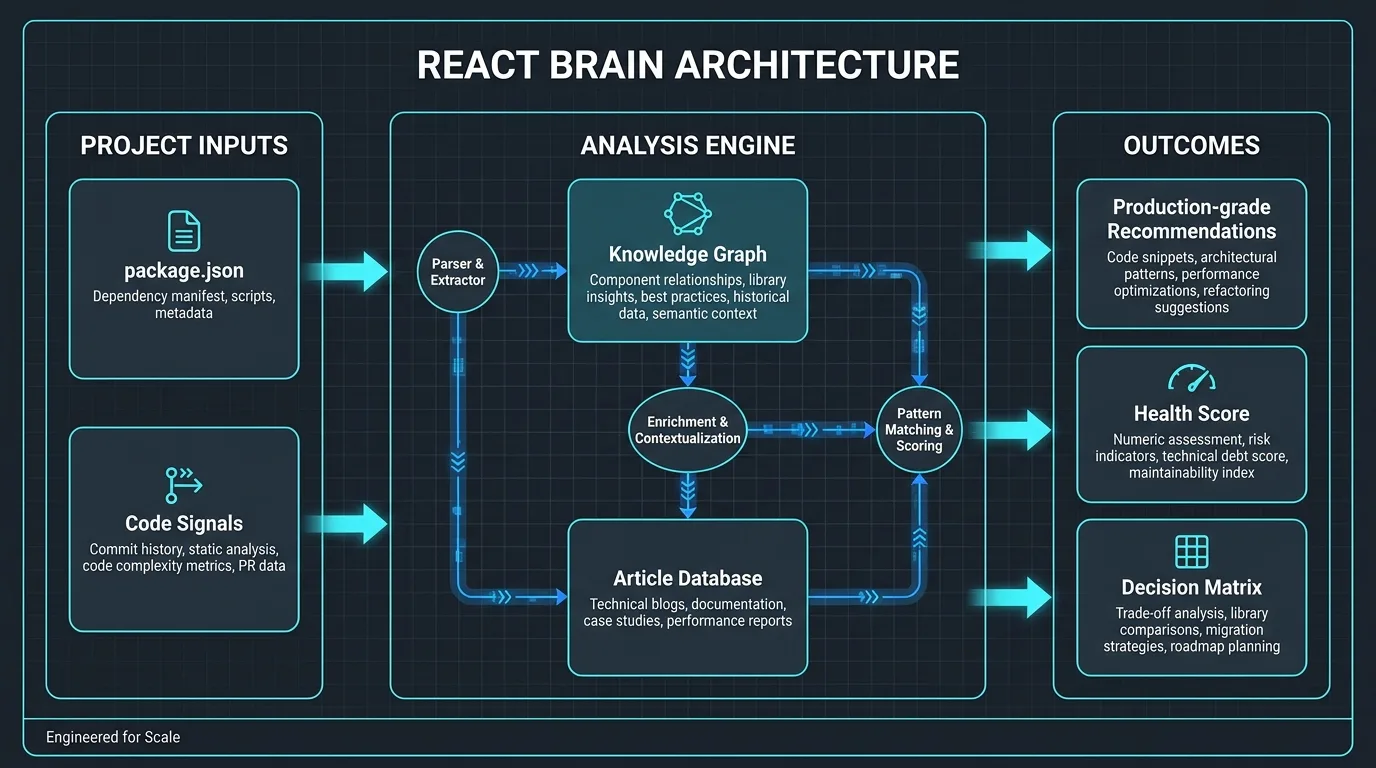
What each block really is
| diagram block | the real thing |
|---|---|
| package.json | The dependency scan: every dep is matched against detection rules each encyclopedia entry declares for itself (detect: — exact names and scope globs). |
| Code signals | Source-level scans: legacy core-API imports (Animated, FlatList, SafeAreaView…) and entry-owned regex signals — the smells a dep-scan can't see (ScrollView rendering a mapped array, secrets in AsyncStorage, fetch-in-useEffect, no error boundary at production stage). |
| Knowledge graph | The encyclopedia: 45 decision entries with options, tradeoffs, and context-keyed recommendations ("GraphQL backend → Apollo"; "P2P app → a client cache is N/A by design"), cross-linked and grouped. |
| Article database | 194 fetch-verified deep-dives with editorial annotations — the curated reading — plus the primary sources each verified fact cites. |
| Pattern matching & scoring | The shared resolver: detected choices vs the entry's context recommendation (✓ aligned / ~ contextual / ↗ review), plus expected-domain gap detection — one implementation shared by the CLI, the MCP server, and this site's doctor. |
| Enrichment & contextualization | The weekly loop: newsletter harvest → fetch-verify every claim → adversarial challenges → live-npm signals (downloads, publish dates) → a reviewed delta. See the methodology and changelog. |
| Production-grade recommendations | The per-decision picks — status- and confidence-badged, dated, sourced. Browse entries. |
| Health score | Calibration, not vibes: every default is a dated falsifiable prediction; resolutions are scored per confidence tier on the scorecard. |
| Decision matrix | Each entry's options-with-tradeoffs table plus the library browser (tracked packages × live npm downloads × owning decision). |
One corpus, three surfaces
The same YAML corpus renders this site for humans, ships as npx react-brain for repos (doctor / stack / learn), and serves coding agents as MCP tools (capsules / query / recommend / doctor / stack). Nothing forks — a weekly corpus update updates all three.